솔직히 말해서, 대만에 살면서 중국이 공격해올 가능성에 대해 전혀 걱정하지 않는다고 말하는 건 거짓말일 것이다.
하지만 미래에 대해 가장 걱정되는 게 무엇이냐고 묻는다면, 전쟁은 내 리스트에서 최우선 순위가 아니다.
내가 더 두려운 것은, 이 나라의 시스템이 조용히 무너지고 있다는 사실이다.
에너지 정책만 봐도 그렇다. “탈원전”을 외치면서 실제로는 화력발전에 의존하고, 공기 오염은 일상이 되어버렸다. 정작 필요한 원자력 안전과 기술에 대한 냉정한 논의는 정치적으로 억압되고 금기시되고 있다. “녹색 에너지”는 특정 업체에 이익을 몰아주는 수단이 되었고, 심지어 조직폭력배와의 연계 의혹도 나오고 있다. “사랑으로 발전하자”는 구호는 이제 “폐로 발전한다”는 현실로 바뀌었다.
사회 보험 제도도 마찬가지다. 해마다 개혁을 외치지만 점점 더 불투명해지고, 보조금, 건설 프로젝트, 경기 부양책 등 예산은 쏟아지는데 문제는 그대로다. 아니, 오히려 더 악화되고 있다.
더 심각한 건, 정부가 국민의 세금을 이용해 자기 홍보를 하고 있다는 점이다. “정책 홍보”라는 이름으로 친정부 언론에 막대한 자금을 투입해 정권 이미지를 포장하고, 반면에 비판이나 견제에는 “친중”, “반대파”, “대만을 사랑하지 않는 자”라는 딱지를 붙인다. 정부에 이의를 제기하는 것만으로도 배신자 취급을 받는 분위기다.
결국, 내가 진짜로 두려운 건 미사일이 아니다. 선택의 자유, 신뢰, 그리고 미래에 대한 희망이 조금씩 사라지고 있다는 사실이다.
적이 없는 건 아니다. 하지만 적이 오기도 전에, 우리가 우리 자신을 먼저 무너뜨리는 건 아닐까?
세상을 바꾸는 건 어렵고, 타인을 바꾸는 건 더 어렵다. 하지만 현실을 직시하고 자기 자신에게 거짓말을 하지 않는 것. 그게 작은 자유를 지키는 첫걸음이다.
이런 말이 있다. “자기 자신을 바꾸면 신이다. 남을 바꾸려 하면 정신병자다.”
농담 같지만, 경고처럼 들린다. 지금 우리에게 필요한 건 더 큰 목소리가 아니라, 이 사회가 잠들기를 바라는 그 순간에도 깨어 있으려는 용기일지도 모른다.
To be honest, in Taiwan, anyone who says they’re not worried about a potential war with China is probably lying.
But if you ask me what I truly fear the most about the future, war isn’t at the top of the list.
What I fear more is the slow collapse of our own systems—right here at home.
Let’s start with energy policy.
While chanting slogans like “Nuclear-Free Homeland,” the government has pushed thermal power plants to their limits, and air pollution has quietly become part of daily life.
Nuclear energy, which deserves rational and open discussion, has been demonized and politically silenced.
Green energy? It’s become a money game—showering subsidies on certain companies, even rumored to be connected with organized crime.
The romanticized idea of “powering with love” has turned into a harsh reality of “powering with our lungs.”
Then there’s the crumbling of our social insurance system.
Every year they say reform is coming, and every year it gets murkier.
Public subsidies, infrastructure projects, and stimulus plans keep flowing, but somehow the problems stay the same—or get worse.
Money is being spent, but it’s hard to see where it’s actually going.
What’s even more frustrating is how the government spends taxpayers’ money to control the narrative.
Under the guise of “policy promotion,” massive budgets are poured into friendly media to paint a glowing picture of their achievements.
At the same time, critics and opposition voices are not met with facts—but with labels.
Disagree with the government? You’ll be branded as “pro-China” or “anti-Taiwan.”
In this twisted game, nationalism becomes a shield against accountability.
At the end of the day, it’s not the missiles that keep me up at night.
It’s the creeping sense that our freedom of choice, trust in governance, and collective future are quietly slipping away.
We do have enemies. But maybe—just maybe—we’ll lose to ourselves before they even arrive.
It’s hard to change the world. It’s even harder to change other people.
But if we can still see clearly and refuse to lie to ourselves, then at least we’ve preserved a sliver of personal freedom.
There’s a saying: “If you can change yourself, you’re a god. If you try to change others, you’re insane.”
It sounds like a joke, but it hits like a warning bell.
Maybe what we need right now isn’t more shouting—just a bit more clarity, and the courage to stay awake in a system that wants us to fall asleep.
“A teacher is one who transmits the Way, imparts knowledge, and resolves doubts.”
— Han Yu, On Teachers
This classic saying has always stayed with me and reminds me to reflect: Who truly deserves the title of “teacher”?
For me, anyone I have met who has inspired me in any of these three ways — transmitting the Way, imparting knowledge, or resolving doubts — I gladly call “teacher.” Whether a positive role model or a cautionary example, their words and actions deserve my study, reflection, and integration.
If someone’s words and deeds are consistent and they provide positive guidance, I believe they can be called a “good teacher.”
When Teaching Becomes Just a Job
However, in our fast-changing era, the role of “teacher” is quietly shifting.
In the United States, especially under the “MAGA” (Make America Great Again) political climate, teachers increasingly resemble corporate employees rather than educators. Hiring and firing emphasize efficiency and compliance, often entangled with office politics.
Being able to teach well is no longer the primary criterion — rather, being compliant is.
Taiwan is also experiencing similar trends.
Teachers face tremendous pressure from students, parents, and school administrations, and mutual trust is rapidly eroding among them all.
The Battlefield of Distrust in Education
Students fear unfairness from teachers; teachers fear complaints from parents; parents fear shirking of responsibility by schools; and schools fear media scrutiny and administrative repercussions.
The entire educational system feels like a battlefield of mutual distrust.
In such an environment, how can teachers quietly transmit the Way?
And how can students freely ask questions and have their doubts resolved?
My Vision of a Teacher
Perhaps precisely because of this disorder and chaos, I want to rethink the essence of teaching.
I often reflect: anyone who has ever inspired me by transmitting the Way, imparting knowledge, or resolving doubts — that person is a teacher to me.
That teacher might be a university professor, a casual friend who once said something meaningful, a role model who motivated me to be better, or even a negative example that warned me what not to become.
Both their actions and words — positive or negative — are worth learning from.
Of course, if a teacher’s words and deeds align and provide positive guidance, I firmly believe they deserve the title “good teacher.”
A Good Teacher is Like Water
I don’t believe a teacher must be a saint.
But if you choose to bear the title, you owe it your fullest respect.
What you transmit must be sincere;
what you impart must be wholehearted;
what you clarify must come from genuine care.
If you have gaps, you must learn;
if you have knowledge, you must share.
Never deliberately mislead, withhold, or hold back — that would betray the virtues of teaching.
I have always believed a truly great teacher is like water:
Gentle and unassuming, yet able to wear through stone;
Embracing all things without pride;
Nourishing the earth without claiming credit.
Teaching as an IT Professional
As an IT staff member in my company, I’m often sent to training sessions, and I also spend personal time after work learning new technologies and concepts.
My learning is never just about “getting by.”
I ask myself:
“If I had to teach this tomorrow, could I explain it clearly?”
I enjoy sharing knowledge. Whenever possible, I proactively give presentations to colleagues and help the team understand new tools or systems.
Even if I don’t get the chance to formally teach, I compile thorough notes and reports — not to check a box, but out of respect for the value of learning.
This is my way of practicing the spirit of teaching as an IT professional: not because of a title, but because I embrace the responsibility and honor it entails.
In That Moment, We Are a Light
Is teaching just a job?
Perhaps, within institutions, it often is.
But in my heart, as long as there are people willing to stand and transmit the Way, impart knowledge, and resolve doubts,
this profession still holds dignity and warmth as a calling.
We may not control how systems evolve,
but we can choose how we approach the role of “teacher” — with respect and sincerity, or with indifference and calculation.
In this era full of uncertainty and skepticism, the identity of “teacher” may be diluted.
But I firmly believe — as long as we seriously commit to transmitting, imparting, and resolving,
each of us can be a teacher in someone’s life.
Whether standing at a podium, sitting at a meeting table, or in that moment debugging code,
when you genuinely pass on what you have learned to others,
A personal story that leads to bigger questions about fairness, sustainability, and what we take for granted
Have you ever had surgery? What for?
My First Surgery Wasn’t Even Mine
Technically, my first “surgical experience” wasn’t something I went through myself —
it was my mother’s C-section, bringing me into the world. It may not have been my body on the table,
but from that moment, I became part of the story.
Later came the more literal surgeries: a childhood fracture from being too playful,
and more recently, the inevitable wisdom tooth removal — listening to the sound of bone being broken under local anesthesia.
Grateful for a System That Never Let Me Worry About Costs
Looking back, I’m genuinely thankful for Taiwan’s healthcare system.
I’ve had injuries, surgeries, emergencies — and not once did I have to hesitate because of money.
With our National Health Insurance (NHI), you can see a doctor for pocket change,
get subsidized hospitalization, and undergo major procedures without financial ruin.
It’s easy to forget how rare and precious that is —
how much of a miracle it is that so many of us can take quality healthcare for granted.
But That Miracle Might Be Cracking
Lately, cracks have started to show.
The NHI is under financial pressure. Medical workers are underpaid, overworked, and many are leaving.
We hear about it often — and yet, we keep using the system the same way.
One of the less discussed problems? Waste.
People going to big hospitals for minor colds Duplicated tests and prescriptions Medicine picked up but never taken Patients (and sometimes doctors) playing it safe by over-using services
Each of these might seem small, but together, they’re pushing the system toward collapse.
The Grey Zone of Overseas Citizens
Then there are people who live abroad long-term but still return to Taiwan to receive healthcare — even major surgeries —
because they still hold Taiwanese citizenship and a valid NHI card.
Legally, it’s allowed. But is it fair?
This isn’t about blaming individuals or suggesting bans.
It’s about asking: Should there be a more balanced contribution model?
Maybe it’s time we consider differentiated premiums, minimum residency requirements, or a tiered access system —
something that reflects both usage and contribution.
Are NHI Premiums Truly Fair?
NHI premiums are income-based in theory.
But in practice, the gap between high-income and low-income contributors is narrow.
Capital gains, overseas income, and asset-based wealth barely factor in.
As with Taiwan’s broader tax system, the burden falls heavily on wage earners —
even though they may not be the heaviest users of the system.
When entitlement and responsibility drift apart, even the best-designed system can start to erode.
So What Can We Do?
Use healthcare responsibly — don’t treat it like a free buffet Respect medical professionals — they’re holding this system together Demand a fairer funding model — one that matches usage with contribution Support thoughtful reforms — before we reach a breaking point
Taiwan’s National Health Insurance used to be something we were proud of.
But without action, it may become something we look back on with regret.
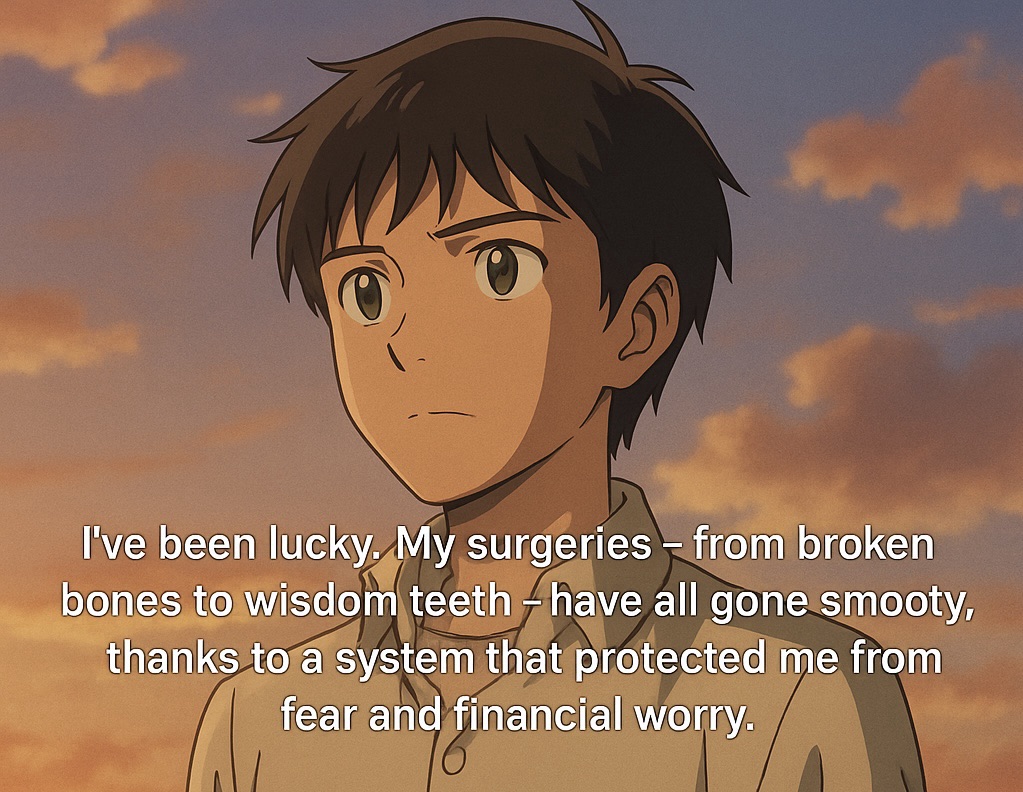
I’ve been lucky. My surgeries — from broken bones to wisdom teeth — have all gone smoothly,
thanks to a system that protected me from fear and financial worry.
But gratitude isn’t enough. We have to protect what protects us.
Because what we take for granted today could disappear tomorrow.
When it comes to “daily habits,” I actually had to think for a while.
I’m not entirely sure which things count as real habits, and which ones are just held together by sheer willpower.
Take climbing the stairs, for example — from two floors underground up to the seventh. I’ve been doing it for years, but honestly, I still have to convince myself every single day:
“Come on, just do it. Otherwise you’re not getting any exercise today.”
That’s not really a habit. It feels more like a conscious choice I make each time.
I know it’s good for me, and I hope I’ll keep doing it, but it never runs on autopilot. It costs effort, every time.
The things that actually feel like habits tend to be softer, yet more stable.
Like calling my girlfriend every day.
Sometimes we talk about our day after work, sometimes it’s just a quick goodnight. But it happens — without ceremony, without reminders. As natural as brushing my teeth.
And then there’s the list of “almost-habits” — the things I wish were habits, but aren’t quite there yet.
I want to code a bit every day, take better notes, scroll less, sleep earlier, get more sunlight…
Sometimes I do, sometimes I don’t. I’m always somewhere between “I should” and “Eh, I’ll give myself a break today.”
Maybe that’s just what life is like for most people.
The things that stick — the ones that truly become habits — are usually tied to emotion, not discipline.
Everything else, no matter how good or logical it sounds, still needs reminders, still takes effort.
And that’s okay.
I believe some things become habits over time.
That daily phone call? It started as a way to stay close, and over time became just part of life.
Maybe all the other things I still have to push myself to do will one day become second nature too.
Are there things you try to practice daily to live a more sustainable lifestyle?
To be honest, I’m someone who wants to be proactive, but in reality, I’m not always that disciplined. When it comes to sustainable living, I’m far from being a role model. Still, if I really think about it, there are a few things I’ve been consistently doing — small efforts, perhaps, but still something.
The one thing I can confidently say I do regularly (and that actually has some visible effect) is taking the stairs at work — from two floors underground all the way up to the seventh floor. No elevator, no carbon footprint, and a decent cardio workout. Two birds, one stone.
Other habits? They’re a bit more hit-or-miss. I try to keep up with my independent programming projects, daily prayer, and — on days when the weather’s good, it’s not too hot, and I don’t have plans after work — I bike to the office. So yes, there’s effort, but definitely not the kind of consistency I’d brag about.
Speaking of “sustainable,” it’s hard not to think of ESG — the trendiest three-letter acronym in today’s corporate world.
Nowadays, even CEOs and board chairs are being called “Chief Sustainability Officers.” It’s like everyone’s trying to save the planet. But in Taiwan, where most industries rely heavily on exports, ESG often ends up being more about compliance than conviction — just something companies need to check off in order to keep selling to the EU or other markets with strict green regulations.
In other words, a lot of what we see is “ESG for the sake of ESG” — also known as greenwashing. Reports get written, labels get slapped on, events are held with pretty photos, but whether any of it truly benefits the environment, improves employees’ lives, or strengthens society? That’s a big question mark.
So compared to those shiny reports filled with buzzwords, I actually trust the small, boring stuff in daily life a lot more. Like my daily staircase climb — no headlines, no fancy design, but it’s real.
Sustainability, in the end, might just mean keeping at it. Even if it’s something small, the goal is to be a little better than yesterday.






 Brassai Kao’s Tech Weave