Write about a random act of kindness you’ve done for someone.
In most cities in Taiwan, we don’t have public trash bins on every street corner.
Instead, garbage trucks come at fixed times during the week, and we all head out like clockwork to catch them.
One evening, I had just finished throwing out my trash when I noticed a woman struggling with two bags—one big, one small—trying to catch up with the garbage truck.
I wanted to help, but I also didn’t want to miss the truck myself.
So I acted like a pickpocket in reverse—swiftly grabbed the big bag out of her hand and dashed toward the truck.
She looked surprised at first, but smiled and thanked me once she realized what I was doing.
It all happened in seconds, but it stuck with me.
Kindness doesn’t always come with preparation—it just needs a window, and a willingness to act.
That moment reminded me of something else.
In Taipei, you don’t often see people begging or living on the street, but once in a while, you do.
Whenever I notice someone like that, I don’t approach them immediately.
I usually walk past quietly, just to observe from a distance and make sure everything seems safe.
If it does, I double back and quietly leave something—a coin, some food.
It’s a similar feeling to the garbage bag moment.
A quiet kind of kindness.
No big gestures, no need to be seen.
Just doing a small thing, if it might make someone else’s day a bit easier.
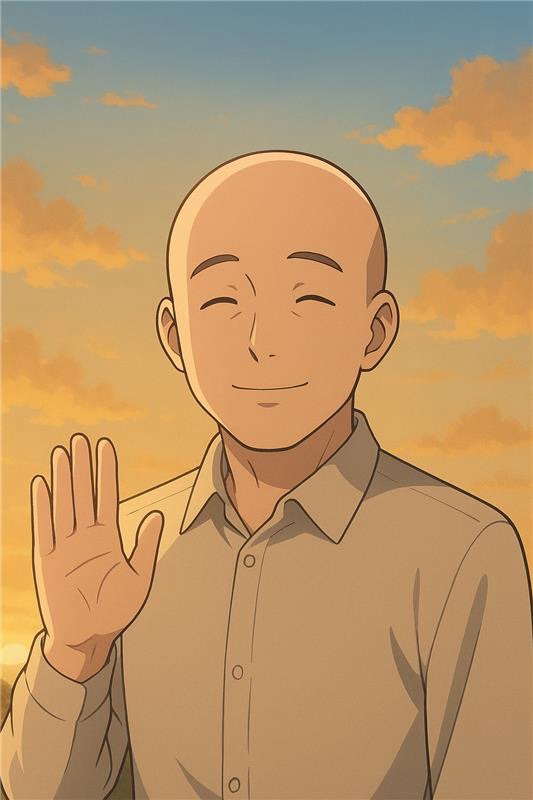
Probably best to start with the most obvious— bald head. Compared to most people my age, the top definitely reflects more light. Not exactly something you can hide, so it often becomes the opening line. It works surprisingly well as an icebreaker.
Not particularly fit, but reasonably balanced. A bit of regular movement, a few stairs, nothing too ambitious— maybe just trying to make up for the baldness, in some small way. 😅
The voice? Softer side. Speech tends to be slow, with pauses. Not from hesitation, but to leave space— for others to respond, reflect, or simply breathe.
Used to rely on examples to explain things. Then came a collaboration with a visually impaired friend last year, and it became clear: the metaphors and visuals that make sense to sighted people don’t always land the same way. So now, more care. Less rush to be “clear,” more time to make sure things actually connect.
That shift in perspective came while developing a product with the team. We had invited a blind friend into the early-stage discussions. For the first time, the question really hit: how would someone get to know you—without ever seeing you?
Turns out, not everything needs to be seen. Some things can be heard. Felt. Understood in quieter ways.
Offerings for ancestors, deities, and occasionally, a “just in case” visit to the local earth god.
Honestly, I’m not against these traditions.
But more and more, I find that even when we want to keep them, it’s not always easy to do it right,
or even just to get it done.
I remember once, one of my elders was gently corrected by a relative—
not because we forgot to offer food, but because we got the order wrong, or the colors of the offerings were off.
After that, they got anxious and started watching traditional ritual programs and reading books to get everything “correct.”
But most of those books assume you live in a spacious countryside home with a big yard,
plenty of space for tables and incense burners.
They don’t exactly account for cramped urban apartments, time constraints, or environmental limits.
Take burning joss paper, for example.
In the past, it was about arranging offerings properly—left side for deities, right side for ancestors.
Now we’ve simplified things a bit: we use low-smoke “eco” paper, and no longer stress over exact positions.
Still, one of the rules my elders insist on is that we must burn it at the front entrance on the ground floor.
The problem? That area is usually crammed with parked scooters.
To clear enough space for a small fire takes serious effort every single time.
We’ve considered using the balcony instead, but that risks damaging the plants.
It’s not that it’s impossible, but every time we go through it, the question remains: is it really worth this much stress?
We’ve Tried Changing Things — Some Worked, Some Didn’t
One year, I suggested we try skipping the paper burning entirely.
“Let’s just light incense,” I said, “and offer our intention sincerely. That should count, right?”
To my surprise, my elders agreed.
That year, we didn’t burn anything—just a quiet, respectful offering.
But afterward, they admitted something felt… missing.
“It just didn’t feel complete,” they said.
Not because of superstition, but because the act itself—the sound, the smoke, the rhythm—had been with them for so long, it became part of what “felt right.”
So Where Do We Go From Here?
We’re still figuring it out, together.
Sometimes we find new ways that feel good. Other times, we fall back into what’s familiar.
And that’s okay. We’ve learned not to push too hard or expect overnight change.
Instead:
We keep looking for practical alternatives, and share what we find with each other
We try to help one another adjust—not by forcing, but by gently understanding where each person is coming from
We focus on staying in conversation, rather than chasing perfection
Every family is different, and so is every solution.
We may not get everything right, and we don’t have to.
What matters most is that we keep showing up for the ritual—not just for tradition’s sake, but for one another.
If the way we adapt still brings us closer, still carries meaning—
then maybe that is the kind of tradition worth keeping.
A family is a family, as long as we find our way through, together.
Honestly, the chance to sit down and have a proper conversation with a complete stranger doesn’t come up that often for me.
Except maybe when I’m camping, I rarely have opportunities to spend time face-to-face with new people.
When I first meet someone, I don’t rush to talk about myself. I usually prefer to listen first, see how the other person opens up. Some people are talkative, some take their time — I’m fine adjusting to different paces.
But if they ask, I usually start by mentioning my work. After all, aside from sleeping, most of my waking hours are spent there.
I work in IT, doing a bit of everything: developing apps, managing systems, fixing bugs, building internal tools, and sometimes even giving training sessions. It’s a bit of a mixed bag, but that means every day is a little different, and I’ve gotten used to it.
Lately, AI has become a hot topic and often comes up in conversation.
If the other person is interested, I’ll talk about voice controls, AI-assisted applications, or projects I’ve worked on. Sometimes the conversation gets technical, sometimes it stays practical — it depends on the situation.
But honestly, more than AI, what I’m really looking forward to right now is an upcoming trip to Japan.
I’m planning the itinerary and have heard a lot of tips from friends. Taiwanese people really share a kind of collective travel memory of Japan — things like buying cosmetics, enjoying yakiniku, visiting shrines, riding the Shinkansen… everyone has their favorite go-to spots.
Talking about travel tends to be more relaxed than talking tech, and people’s faces usually light up much faster.
As for politics — a topic often stirred up here in Taiwan — I generally avoid discussing it and have no desire to convince anyone.
Sometimes, it’s enough just to listen. Differences in opinion aren’t a big deal; what matters more is keeping the conversation comfortable.