
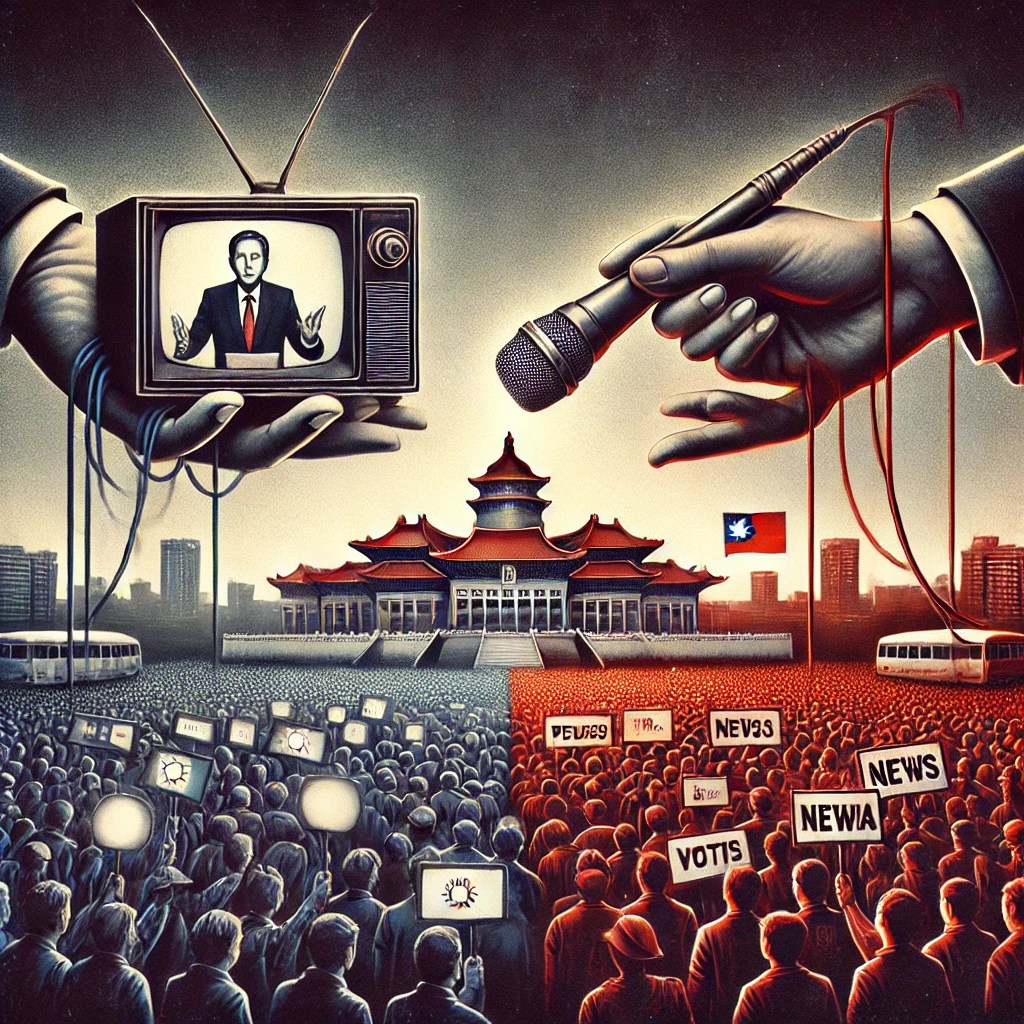
Media Control and Political Influence
Taiwan’s media landscape is deeply intertwined with political and business interests. Many major news outlets are owned by corporate elites who maintain close ties with political parties. According to Herman and Chomsky’s “Propaganda Model” of media control, ownership, advertising revenue, and political pressure shape the news that reaches the public. In Taiwan, this is evident in media conglomerates favoring candidates who support their business interests while suppressing or distorting opposing views. This lack of media independence undermines the democratic process, as voters receive biased information that influences their political decisions.
Unbalanced News Reporting
Journalistic ethics require balanced reporting, but Taiwan’s media often fails to meet this standard. Studies on agenda-setting theory, such as those by McCombs and Shaw, suggest that media dictates public perception by emphasizing certain issues while ignoring others. This is particularly visible during election periods, where certain news networks frame government policies in an overly positive light while portraying opposition figures as threats to national stability. Reports often exaggerate scandals involving political opponents while downplaying or ignoring corruption cases linked to the ruling party. This selective reporting creates a distorted public perception, steering political discourse in favor of those who control the media.
Fake News and Misinformation
The spread of fake news in Taiwan has been widely documented. Research in media framing and misinformation, such as that by Lippmann and Kahneman, explains how cognitive biases make people susceptible to emotionally charged falsehoods. Taiwan’s political landscape has witnessed fabricated news stories spread through television, online platforms, and social media. Political actors and media organizations manufacture narratives that provoke fear, patriotism, or anger to manipulate voter behavior. For instance, accusations of foreign interference are frequently used to discredit opposition candidates, while misleading economic statistics are presented to glorify ruling party achievements. The deliberate use of misinformation erodes public trust and weakens democracy.
Media as a Political Weapon
Politicians in Taiwan utilize media as a tool for character assassination. The concept of “weaponized media” aligns with political communication theories, where information is strategically manipulated to shape public opinion. Accusations of corruption, espionage, or incompetence are repeatedly broadcasted against opposition leaders, even in the absence of solid evidence. This phenomenon aligns with the “trial by media” effect, where individuals are condemned in the public eye before any judicial verdict is reached. Once a negative narrative is established, it is difficult to reverse, damaging reputations and influencing elections. Meanwhile, politicians in power receive favorable coverage, with scandals involving them either downplayed or omitted entirely.
Case Studies: Elections and Policy Changes
Several elections in Taiwan have demonstrated the significant impact of media bias. During past presidential and legislative campaigns, certain TV channels provided overwhelmingly positive coverage of government-affiliated candidates while relentlessly attacking the opposition. One notable example occurred when a leading opposition figure was accused of espionage with no substantial evidence, a claim that dominated headlines for weeks. The negative framing contributed to public distrust and electoral defeat. Similarly, policy changes regarding media regulation have been influenced by media pressure itself, ensuring that favorable laws are passed to benefit conglomerates that support the ruling party. This interdependence between media and politics highlights the systemic nature of the problem.
Public Trust and the Need for Reform
Trust in media is declining in Taiwan, with many citizens recognizing the extent of bias and manipulation. The rise of alternative media platforms reflects an effort to counterbalance mainstream narratives, but the problem persists. Media law reforms, inspired by European models of public broadcasting independence, have been proposed to reduce corporate and political influence in journalism. Strengthening fact-checking organizations and increasing transparency in media ownership are crucial steps toward restoring credibility. Without these changes, Taiwan’s democratic system will remain vulnerable to manipulation by the powerful few who control information.
當新聞不再中立:台灣媒體如何影響選舉與政策
台灣媒體的中立性越來越受到質疑。許多媒體機構背後的金主與政治勢力有密切聯繫,這使得新聞報導變得偏頗,常常無法呈現事件的兩面性。尤其在選舉期間,媒體常被用來攻擊政治對手,並傳播不實資訊,這樣的操作會影響選民的選擇,甚至造成對民主制度的信任危機。
媒體的不平衡報導,不僅加劇了政治敵對情緒,也使得某些政黨能夠利用媒體優勢來操作輿論,強化自身的政治利益。許多案例顯示,媒體能夠透過選擇性報導,強化某些候選人的形象,而忽略或抹黑其他候選人,從而對選舉結果產生影響。
在這樣的情況下,台灣的公眾對媒體的信任逐漸降低。若不進行媒體改革,台灣的選舉與政策將始終受到權力與財富的控制,這對民主發展將產生長遠的不良影響。因此,強化新聞的獨立性與公正性,並設立有效的監督機制,已成為當前急需解決的問題。
 Brassai Kao’s Tech Weave
Leave a comment